One of the most fascinating and distinctive features of Traditional Chinese Medicine is something many Westerners have never heard of: Pao Zhi (炮制), the ancient art of herb processing. This practice transforms raw medicinal substances through techniques like roasting, steaming, or soaking in liquids such as wine, vinegar, or honey—fundamentally altering their therapeutic properties.
Understanding the difference between processed and unprocessed herbs isn't just academic. It can mean the difference between an effective treatment and a disappointing one, or in some cases, between safety and harm.
What is Pao Zhi?
Pao Zhi refers to the various methods used to prepare Chinese medicinal substances before they're prescribed to patients. The practice dates back over 2,000 years, with the earliest references found in ancient texts like the Wu Shi Er Bing Fang (Formulas for 52 Diseases).
Raw herbs harvested from the field go through several stages before use in clinical practice. First, they're cleaned of sediments and impurities, then dried. At this point, an herb is considered "Sheng" (生)—meaning raw or unprocessed. Many herbs are then subjected to additional processing, which is where Pao Zhi comes in.
Why Process Herbs at All?
Processing serves several important purposes in Chinese herbalism.
- Reducing toxicity and side effects stands as one of the primary reasons for processing. Some herbs in their raw state can be harsh on the digestive system or even dangerous. Processing transforms these substances into safer, more usable medicines. The case of Aconite (Fu Zi) provides the most dramatic example—the fresh plant is deadly poisonous, yet through careful processing, it has been safely used in Chinese medicine for nearly two millennia. Historical texts document over forty different methods for processing this single herb.
- Enhancing therapeutic effects represents another key goal. Processing can amplify an herb's beneficial properties or focus its action on particular conditions. When Licorice root (Gan Cao) is fried with honey, for instance, its ability to tonify the Spleen and augment Qi becomes significantly stronger.
- Directing action to specific organs is achieved through processing with particular substances. Adding salt during processing guides an herb's effects toward the Kidneys. Wine processing enhances blood-moving properties. Vinegar directs action to the Liver.
- Moderating an herb's nature occurs through various processing techniques. TCM categorizes herbs by their thermal nature—hot, warm, neutral, cool, or cold. Processing can shift an herb along this spectrum, making a cold herb gentler or a harsh herb more harmonious with the digestive system.
Common Processing Methods
Traditional Pao Zhi encompasses numerous techniques, each with specific applications.
Dry Stir-Frying (Chao)
Herbs are heated in a wok without any liquid, typically until they turn yellow or slightly brown. This method is often used to strengthen an herb's ability to support the Spleen and digestion. Bai Zhu (White Atractylodes) becomes better at fortifying the Spleen when dry-fried, whereas the raw form is more suited for treating edema.
Stir-Frying with Adjuvants
Various substances can be added during stir-frying to modify an herb's properties.
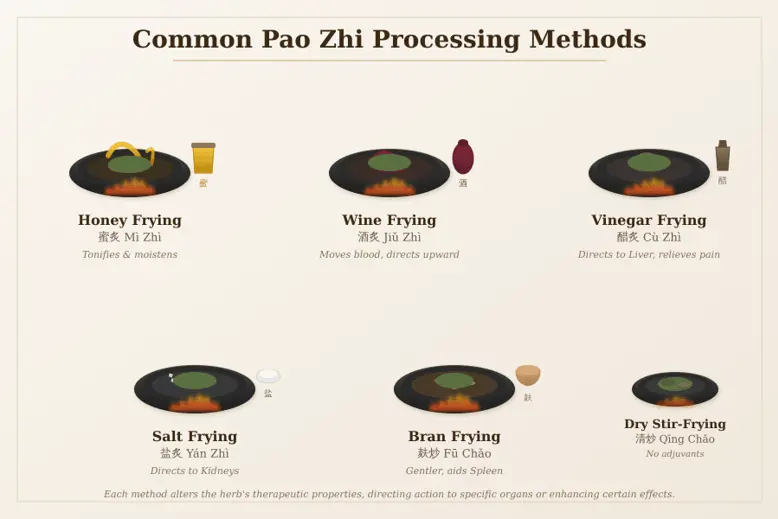
Honey frying (Mi Zhi) moistens and tonifies. Honey-fried Huang Qi (Astragalus) has enhanced Qi-tonifying properties compared to the raw root.
Wine frying (Jiu Zhi) enhances circulation and directs action upward and outward. Dang Gui processed with wine has stronger blood-moving effects.
Vinegar frying (Cu Zhi) enhances Liver-directing properties and helps with pain relief.
Salt frying (Yan Zhi) directs herbs to the Kidney system and can help nourish Yin.
Ginger juice processing warms the Stomach and reduces the tendency of some herbs to cause nausea.
Bran frying (Fu Chao) is often used to moderate the drying properties of certain herbs, making them gentler on the digestive system. Cang Zhu (Atractylodes) becomes less harsh after bran frying, as the process dissipates some of its potentially irritating volatile oils.
Steaming (Zheng)
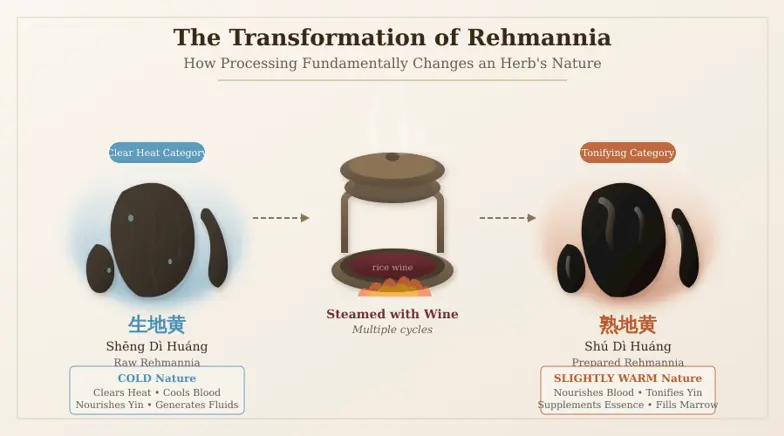
Prolonged steaming can fundamentally transform an herb's character. The classic example is Rehmannia root (Di Huang). In its raw form (Sheng Di Huang), it clears heat and cools the blood—a cold-natured herb used for warm diseases. After steaming with wine, it becomes Shu Di Huang, which shifts to a slightly warm nature and primarily nourishes Blood, Yin, and Essence. These two forms of the same root occupy entirely different categories in the materia medica.
Calcining (Duan)
Herbs, particularly minerals and shells, are heated at high temperatures. This can make substances easier to grind and modify their therapeutic effects.
Charring (Tan)
Herbs are heated until they turn dark brown or black but not reduced to ash. Charred herbs often develop enhanced ability to stop bleeding. Many blood-moving herbs are charred when the clinical goal is hemostasis.
Practical Examples: Same Herb, Different Effects
Understanding a few key examples helps illustrate how profoundly processing can change an herb's application.
Da Huang (Rhubarb Root)
Raw Da Huang is famously powerful for purging accumulation from the intestines—it's a strong purgative. When processed with wine, it becomes better at clearing heat from the upper body and moving blood. Charred Da Huang (Da Huang Tan) loses most of its purgative effect but gains the ability to stop bleeding.
He Shou Wu (Polygonum multiflorum)
This distinction is crucial for safety. Raw He Shou Wu has entirely different properties than the prepared form. The unprocessed root is primarily used to detoxify and moisten the intestines, but it can be harsh on the Liver. Prepared He Shou Wu (Zhi He Shou Wu), which has been steamed with black beans, becomes a premier Blood and Essence tonic—one of TCM's most valued longevity herbs. Most He Shou Wu you encounter in supplements and formulas should be the prepared variety.
Hou Po (Magnolia Bark)
Raw Magnolia bark can irritate the throat, causing discomfort when taken as a decoction. For this reason, Hou Po is typically processed with ginger juice before use. Most Magnolia bark that arrives at pharmacies has already undergone this processing.
Ban Xia (Pinellia)
This herb is never used raw in internal medicine—it would be too harsh and potentially toxic. Various processing methods produce different preparations: Fa Ban Xia (processed with licorice and lime) is the standard form for drying Dampness and transforming Phlegm. Jiang Ban Xia (ginger-processed) is better for Stomach issues and vomiting.
Why This Matters for You
If you're using Chinese herbal products, whether formulas or single herbs, the processing method can impact the results you experience.
For practitioners prescribing raw herbs, specifying the correct processed form is essential. Writing simply "Huang Qi" when you need the honey-fried version means your patient may receive an herb less suited to their condition. Classic formulas like Bu Zhong Yi Qi Tang traditionally call for specific preparations—substituting raw herbs for processed ones alters the formula's character.
For those taking prepared products, understanding that manufacturers should be using properly processed herbs helps you evaluate quality. Reputable suppliers process their herbs according to pharmacopeial standards and traditional methods.
For safety considerations, some herbs require processing before they're safe for internal use. Aconite products, certain forms of Ban Xia, and others must undergo proper preparation. This is one reason why sourcing herbs from established suppliers following traditional methods matters greatly.
The Art and Science Combined
Modern research has begun to illuminate the mechanisms behind traditional processing methods. Scientists can now track how chemical profiles change during different Pao Zhi procedures—measuring reductions in toxic alkaloids, increases in beneficial compounds, or changes in solubility. This work validates much traditional knowledge while also helping standardize processing for consistent quality.
Yet Pao Zhi remains fundamentally an art guided by TCM theory. The selection of which processed form to use for a particular patient depends on classical pattern differentiation—understanding the patient's constitution, the nature of their imbalance, and the therapeutic strategy required.
This integration of ancient wisdom and practical clinical observation is what makes Chinese herbalism so distinctive. The next time you take a Chinese herbal formula, consider that many of those herbs have been thoughtfully transformed through methods refined over millennia—each processing step representing accumulated clinical experience about how to make plant medicine work better for the human body.
At Me & Qi, we believe in making the wisdom of Traditional Chinese Medicine accessible. Understanding concepts like Pao Zhi helps you become a more informed participant in your own health journey. Have questions about Chinese herbal medicine? Explore our Knowledge Base or browse our store for quality TCM products.